Understanding Your Scottish Terrier's Coat: What Every Owner Should Know
Understanding Your Scottish Terrier's Coat: What Every Owner Should Know
The Scottish Terrier's coat is functional engineering wrapped in a distinctive silhouette. It was built to keep a small, low-slung dog comfortable while hunting through the rough terrain and unpredictable weather of Scotland. Understanding what's going on with that coat -- why it behaves the way it does, what it needs from you, and what happens when it's neglected -- makes you a better Scottie owner.
The Wire Double Coat Explained
Your Scottish Terrier has a true double coat made up of two distinct layers:
The outer coat consists of hard, wiry guard hairs that are dense and slightly rough to the touch. These hairs stand slightly away from the body and create the Scottie's characteristic rough-textured appearance. The outer coat is the breed's first line of defense -- it repels water, sheds dirt, and provides a physical barrier against scrapes and thorns.
The undercoat is shorter, softer, and much denser than the outer layer. It sits close to the skin and acts as insulation. In cold weather, it traps body heat. In warm weather, it creates an air buffer that provides some protection from heat.
Here's a fact that catches most new Scottie owners off guard: the Scottish Terrier's coat is so dense that you can part it to the skin on the back and the hair on either side will stand up like walls. Very few breeds have this level of coat density relative to body size. It's one of the reasons grooming takes longer than you'd expect for a 20-pound dog.
The two layers work together as a system. When one layer is neglected -- a packed undercoat, dead outer coat left in place -- the whole system breaks down.
Scottish Terrier Coat Colors
Scotties come in three recognized color groups, and each has slightly different grooming characteristics:
Black: The most iconic Scottie color. Dense, rich black from root to tip in a properly maintained coat. Black Scotties show dander and lint more visibly, so they benefit from regular brushing for appearance as well as health. Clipped black coats tend to fade to a dark grey-charcoal over time.
Brindle: A pattern of dark and light stripes woven through the coat. Brindle can range from very dark (nearly black with subtle striping) to quite light (gold-tan with dark stripes). Brindle coats are often where hand-stripping really shines -- the stripped coat shows much richer, more defined brindle patterning than a clipped coat.
Wheaten: A warm, golden to pale straw color. The rarest of the three and sometimes confused with a West Highland White Terrier from a distance. Wheaten coats can show staining more easily, particularly around the mouth and eyes, and may need more frequent facial cleaning.
Regardless of color, the coat structure and density are the same. Your grooming routine doesn't change based on color -- but your product choices might. Dark coats benefit from color-enhancing shampoos, while wheaten coats may need brightening formulas.
How the Wire Coat Growth Cycle Works
This is the most important thing to understand about your Scottie's coat, and it's where wire-coated breeds differ fundamentally from most dogs.
In a typical shedding breed, hair goes through this cycle:
In wire-coated breeds like Scottish Terriers, the exogen phase barely happens. Dead hair stays lodged in the follicle instead of falling out. New hair tries to push through alongside the dead hair, resulting in:
- Texture loss -- new soft growth mixed with dead wiry hair creates an inconsistent feel
- Color fading -- dead hair loses pigment while new growth has it, creating a washed-out appearance
- Follicular congestion -- multiple hairs competing for the same follicle space can irritate the skin
- Matting from within -- dead coat tangles with new growth and undercoat below the surface
The Beard, Eyebrows, and Skirt
Scottish Terriers have three areas of longer, softer furnishings that need different care than the body coat:
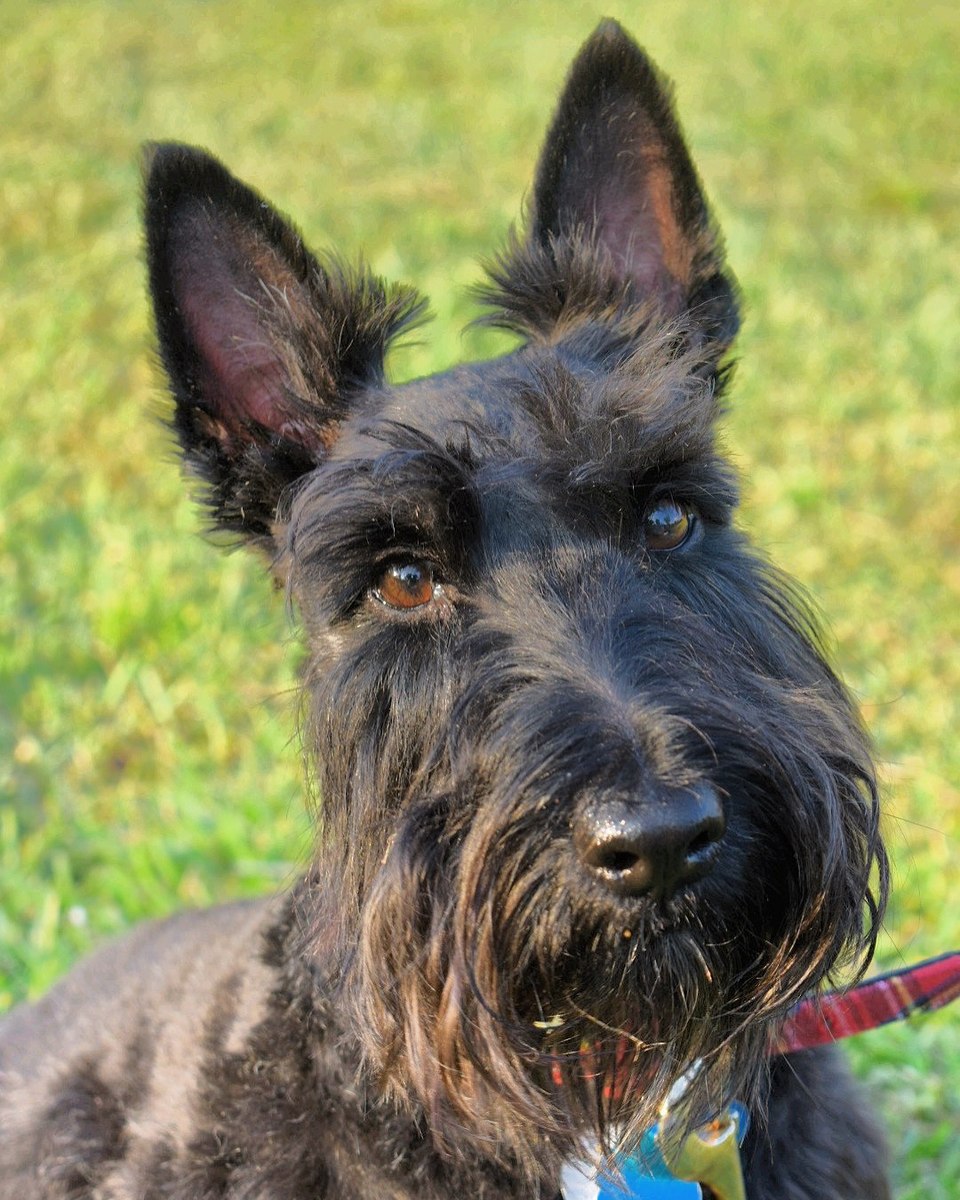
The beard is the Scottie's signature facial feature -- a dense, forward-projecting mass of hair on the muzzle. It gives the breed its distinctive square-faced look. The beard is softer than the body coat and grows continuously, needing regular trimming for shape and length. It's also a magnet for food, water, and drool.
Grooming note: the beard should be combed daily and washed weekly. A clean, shaped beard frames the face properly. A neglected beard hangs, mats, and develops odor.
The eyebrows are longer hairs that grow forward over the eyes, creating the Scottie's characteristically intense, watchful expression. They need trimming to maintain expression without blocking vision. Over-trimming the eyebrows dramatically changes the Scottie's facial character -- they should look keen and alert, not surprised or bare.
The skirt is the longer hair that falls from the lower sides and belly. It creates the Scottie's low, flowing underline and contributes to the breed's unique silhouette. The skirt needs regular combing to prevent matting and occasional trimming for evenness. In wet weather or after swimming, the skirt holds moisture and needs thorough drying.
Common Scottish Terrier Coat Problems
Skin Conditions
Scottish Terriers are more prone to skin issues than many breeds. The dense coat creates a warm, humid microclimate against the skin that can promote:
- Allergic dermatitis -- environmental allergies that show up as itching, redness, and coat thinning
- Sebaceous cysts -- small fluid-filled bumps under the skin, relatively common in Scotties
- Hot spots -- especially under the skirt and in the armpits where the dense coat traps moisture
Matting
The Scottie's coat mats in predictable places:
- Under the front legs (armpits)
- Behind the ears
- In the skirt, especially between the hind legs
- Under the collar or harness
- In the beard, particularly under the chin
Coat Texture Changes
As discussed, clipping changes the coat texture over time. But other factors also affect the Scottie coat:
- Age -- senior Scotties often develop softer, thinner coats
- Health conditions -- hypothyroidism, which Scotties are somewhat prone to, can cause coat changes including dullness, thinning, and slow regrowth
- Nutrition -- a diet low in essential fatty acids shows up in coat quality rapidly
- Hormonal changes -- spaying or neutering can soften the wire texture
Caring for Your Scottish Terrier's Coat at Home
Weekly Routine
- Brush the body coat once or twice per week with a slicker brush, working through to the skin
- Comb the beard every 1-2 days with a steel comb
- Comb the skirt every 2-3 days, checking for tangles
- Wipe the beard after every meal and water session
- Check ears weekly for debris and moisture
Products to Use
- Wire coat shampoo -- cleans without softening; avoid anything labeled "moisturizing" or "softening" for the body coat
- Stripping knife or stone -- for light maintenance between professional grooms
- Slicker brush -- your everyday tool for the body
- Steel comb -- for beard, skirt, and eyebrow maintenance
- Ear cleaning solution -- gentle, dog-specific formula
What to Avoid
- Conditioner on the body coat -- softens the wire texture. Use only on the beard and skirt if needed for detangling.
- Over-bathing -- the wire coat produces natural oils that maintain its texture. Bathing every 4-6 weeks is sufficient unless the dog is genuinely dirty.
- Silicone-based products -- coat the wire hairs and reduce their natural dirt-shedding properties.
- Shaving -- never shave a Scottish Terrier. The double coat provides temperature regulation and skin protection. It may not grow back properly.
The Coat Tells the Scottie's Story
A Scottish Terrier in proper coat is unmistakable -- crisp texture, rich color, clean silhouette, sharp beard, alert eyebrows. It's one of the most recognizable profiles in the dog world. That look is the result of regular, knowledgeable care applied to a coat that was built for function and refined for form.
Understanding your Scottie's coat transforms grooming from a chore into an informed routine. You know why the beard mats, why the coat fades, why the undercoat packs. And knowing why means knowing how to prevent problems before they start. That's the difference between managing a coat and understanding it.
---
Ready to streamline your grooming workflow? PawOps Board Manager helps salons track every Scottish Terrier from check-in to pickup with real-time visibility. Start your free 30-day trial →