Understanding Your Cesky Terrier's Coat: What Every Owner Should Know
Understanding Your Cesky Terrier's Coat: What Every Owner Should Know
The Cesky Terrier's coat tells the story of deliberate genetic design. In 1948, Czech geneticist Frantisek Horak set out to create a terrier that was practical to groom, pleasant to touch, and functional in the field. He crossed the Sealyham Terrier with the Scottish Terrier, selected specifically for a softer, silkier coat that could be maintained with clippers rather than the labor-intensive hand-stripping that other terrier breeds require.
The result is a coat that is unique in the terrier world -- and understanding it helps you care for it properly.
How the Cesky Coat Differs From Other Terriers
The Cesky Terrier breaks nearly every "rule" of terrier coats:
| Feature | Typical Terrier | Cesky Terrier | |---------|----------------|---------------| | Texture | Harsh, wiry | Fine, silky, slightly wavy | | Grooming method | Hand-stripped | Clipped | | Shedding | Minimal (dead coat stays) | Minimal (continuous growth) | | Growth pattern | Grows to set length, stops | Grows continuously | | Undercoat | Dense, separate from outer | Minimal, blends with outer coat |
The Cesky's coat is more similar to a Cocker Spaniel or soft-coated breeds than to wire terriers. This is entirely intentional -- Horak wanted to eliminate the need for stripping while keeping a coat that protected the dog in the field.
The Dramatic Color Change
The Cesky Terrier undergoes one of the most dramatic color transformations in the dog world.
Birth Color
All Cesky Terrier puppies are born one of two colors:
- Black -- which will lighten to various shades of gray-blue
- Chocolate/brown -- which will lighten to various shades of coffee-brown
The Lightening Process
Starting around 2 to 3 months of age, the coat begins to lighten. This process continues gradually for the first two to three years of the dog's life. The rate and final shade vary between individuals.
Adult Colors
Gray-blue dogs (from black puppies) range from:
- Dark charcoal gray
- Medium steel blue-gray
- Light silvery gray
- Platinum (very pale)
- Dark coffee
- Medium brown
- Light cafe au lait
Why This Matters for Grooming
The color change means your Cesky will look different at every stage of its life. What is groomed off today grows back slightly lighter. A freshly clipped area may appear darker than the longer surrounding coat simply because the shorter, newer hair has not lightened as much yet.
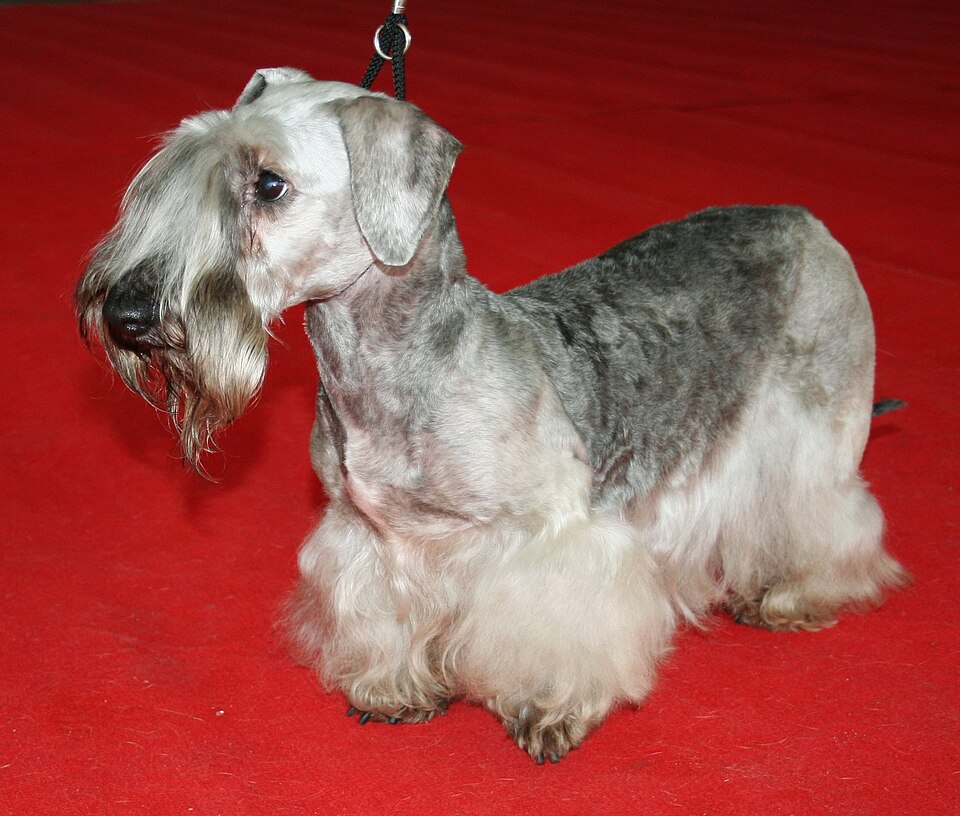
This color variation between clipped and unclipped areas is normal and expected. It actually adds visual depth to the Cesky's appearance -- the shorter upper body may be a shade or two darker than the longer furnishings, creating a natural gradient effect.
According to the American Cesky Terrier Fanciers Association, the final adult color should not be judged before three years of age, as the lightening process continues well past what most owners expect.
The Coat in Sections
The Clipped Areas (Upper Body)
The head, ears, cheeks, throat, shoulders, and upper body are clipped short. This area shows the newest growth and is often slightly darker than the furnishings. The texture in these areas feels smooth and close, like velvet when freshly clipped.
The Transition Zone
The area where clipped meets long is the most technically challenging part of Cesky grooming. There should be no abrupt line -- just a gradual lengthening from short to long. This blended transition is what gives the Cesky its flowing, elegant outline rather than a sharp, scissored look.
The Furnishings (Lower Body and Legs)
The chest, belly, lower sides, and legs carry longer coat that flows and moves. This hair is the silkiest part of the Cesky coat and also the most prone to tangling. It needs regular combing to stay separated and flowing rather than clumping into mats.
The Facial Hair
Cesky Terriers have a moderate beard and soft brow fringe -- less dramatic than a Schnauzer but more pronounced than a smooth-coated breed. The eyebrows create a gentle frame for the eyes rather than the sharp arches seen on some terrier breeds.
Coat Texture and Behavior
Why It Tangles
The Cesky's fine, slightly wavy texture tangles for the same reason human fine hair tangles -- the individual hairs are thin enough to wrap around each other easily, and the wave pattern creates friction points. Unlike coarse wire coats that resist tangling because the stiff hairs push away from each other, fine Cesky coat hairs attract each other.
Seasonal Changes
The Cesky's coat is relatively consistent year-round, without the dramatic seasonal blowouts seen in double-coated breeds. You may notice slightly more loose hair during spring and fall transitions, but nothing approaching the shedding levels of breeds with thick undercoats.
Texture Preservation
The silky texture is maintained through regular conditioning. A dry, brittle Cesky coat tangles faster and breaks more easily than a well-conditioned one. Conditioning shampoo at every bath and a leave-in detangling spray between baths keep the coat in optimal condition.
A Coat Fact That Surprises Most Cesky Owners
Here is something that catches people off guard: the Cesky Terrier's coat is one of the easiest terrier coats to maintain once you understand its needs -- but one of the hardest to recover from neglect.
A well-maintained Cesky with a good home brushing routine needs straightforward professional care. The coat clips cleanly, the furnishings fall nicely, and the entire groom flows efficiently.
But a neglected Cesky whose furnishings have matted becomes exponentially harder to fix. The fine, silky texture mats tightly against the skin in a way that coarse wire coats do not. Fine-hair mats are denser, tighter, and more painful to remove than coarse-hair mats. A Cesky that has been neglected for even three to four weeks can develop mats that require shaving rather than combing.
The lesson: consistency is everything with this coat. Small, regular efforts prevent large, painful corrections. Ten minutes of brushing three times a week beats a two-hour emergency de-matting session every couple of months.
Home Care Routine
- Every 2 days: Comb through furnishings with a steel comb. Focus on behind the elbows, the belly, and behind the ears.
- Twice weekly: Full brush-out with a slicker brush or pin brush.
- After outdoor activity: Quick check of belly and leg hair for debris.
- Weekly: Ear check and clean. Beard wipe.
- Between grooms: Light detangling spray before brushing.
Tools for Cesky Coat Care
- Steel comb (medium teeth) -- your primary tool for checking furnishing condition
- Slicker brush or pin brush -- for full brush-outs
- Detangling spray -- essential for reducing breakage and easing tangles
- Conditioning shampoo -- maintains the silky texture between grooms
- Gentle dryer -- for spot-drying after wet weather